


“Leadership – that’s possible with a good team and a bit of talent on the side!” Is that true? Can leadership really be done “on the side”?
Requirements for managers
The topic of employee management is becoming increasingly important. Why this is the case can be explained by taking a look at our current framework conditions in which leadership takes place in everyday working life: We live in a (working) world in which customer demands are constantly increasing. The service character of our work is also becoming increasingly important. More sophisticated work systems and work organizations are being used or introduced. At the same time, the stability and duration of existing systems is becoming shorter and shorter. At this point, it is important to take employees with us and involve them in changes. Good management work must create a framework in which performance is possible, and change is a constant companion to our work and also shapes the interaction at the interfaces in our day-to-day business. And since it is well known that not everyone is happy about change, managers play a particularly important role in times of change.
Successful managers must
– be aware of their roles and tasks and actively accept them. You also have to take on leadership roles that you are not entirely comfortable with.
– think and act entrepreneurially and thus, together with their team, make their contribution to the implementation of the corporate strategy.
– master everyday situations.
– Recognize and deal with conflicts in the team and at the interfaces.
– ask themselves how they can increase their and their employees’ efficiency.
– be aware that the demands on them are increasing and find mechanisms to protect themselves from overload
Operational management
Leadership takes time. Not every manager finds it easy to remain in the role with the necessary degree of consistency and to continuously tackle leadership tasks. Because in day-to-day business, this means that you have to make time for leadership, which is then lacking elsewhere. However, if you want to be successful as a manager and be accepted as such by your employees and higher hierarchical levels, you need to make time for this on a regular basis! Being a manager means that you have to be aware of your tasks and actively accept them, even if you think you “don’t really have time for them”.
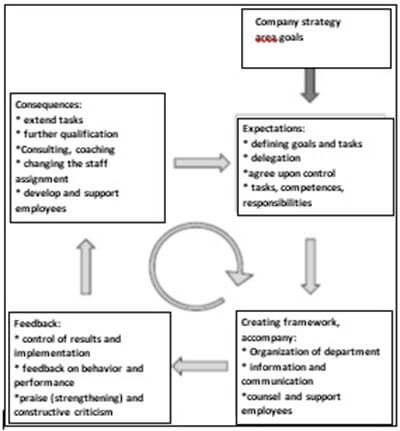
Let’s take a closer look at the operational management tasks. Every employee must feel their manager in all four areas (see diagram below). Then they also feel well “led” and are able to perform optimally. This is the only way to create a successful and trusting working relationship with the line manager. The employee realizes that the manager takes the “time” for them and feels valued as a person.
It is also worth reflecting on yourself as a manager at regular intervals, if necessary with professional support, and asking yourself whether you are applying and using the management tools correctly.
It should also be borne in mind that, as a rule, a team and not just individuals have to be led to success.
Even when looking at operational management tasks, i.e. the day-to-day management work of a manager, it becomes clear that management is not something that can be done “on the side”, but that you have to actively plan and take time for it.
Strategy-implementing leadership
The divisional and departmental objectives are derived directly from the corporate strategy. It is important that managers do not lose sight of these in their day-to-day business decisions. Decisions that influence the future, such as
– The well thought-out and, if necessary, modified requirements profile for the search for new employees
– Personnel development measures with an impact on the achievement of operational objectives
– Substitution rules to promote potential, to relieve team members or the manager or to distribute knowledge
– Succession planning
– etc.
The decisions must always be made with a strategic perspective. This means that managers must ask themselves the following questions, among others:
– What do I have to do or decide today so that I am successful tomorrow and can contribute to the fulfillment of the corporate strategy?
– What skills, abilities and knowledge will I need in my team in the future?
– Who can best take on which tasks?
– Where can conflicts arise?
– Is each of my employees deployed according to their strengths?
– Do I have to change anything in the way I deploy employees?
– Does everyone know what they have to do, what the upstream and downstream processes are and why their task is important and significant?
– Have I succeeded in communicating with my team and ensuring a good flow of information?
Conclusion
Good and successful leadership does not happen “on the side”. When leadership is a side issue, leadership is only dealt with as a side issue – we all know what that means. Decisions are made as usual or, in the worst case, not at all, good employees leave the company, there is a lack of leaders in the teams, managers are too deeply involved in day-to-day business and take care of many things that other team members could also take on, areas do not develop or only develop slowly, et cetera.
Leadership can be trained. If you compare good managers in companies with top athletes, the following parallels can be drawn: Top athletes are very good performers. And they train every day, seek advice, receive coaching and reflect on their performance. Good managers do the same and are aware that leadership is a field in which you never stop learning. This is precisely what makes the management position so interesting and exciting for them. Successful managers enjoy taking on their leadership roles every day with passion and are aware of the contribution they make to the success of the company – together with their team, which they constantly strengthen and of which they are very proud!
by Eika Schoenmakers, trainer at Lorenz-Seminare