


Today, numerous influencing factors determine whether a company achieves long-term success, falls into mediocrity or even disappears from the market altogether. One important intersection that unites the majority of successful companies is a well-founded, sustainable management of their talent that is geared to the realities of our time. This also includes the regular assessment of the performance of all employees (if possible) and the corresponding feedback of the assessment and its consequences to the individual by the direct superior.
It all starts with the analysis
It is well known that there are managers who do not know some of their employees or who assess the performance of their team members based on the situation and purely “from the gut”. However, in order to enable a systematic and fact-based assessment of performance, clearly defined requirements regarding the competencies and expected behavior of the employee in their position are needed first – as a kind of preliminary effort on the part of the company. It is essential to keep an eye on the requirements arising from the constant, dynamic changes of our time and to adapt expectations accordingly (e.g. digital leadership skills, intercultural skills, etc.).
On this basis, it is then up to the direct superior to carry out a regular target/actual comparison between the requirements of a position and their fulfillment by the employee and to determine and document the degree of fulfillment as well as deviations from what is desired. The trick is to do this as impartially as possible, over a longer period of time (e.g. one year) and with numerous examples.
Communication
The next step is to communicate the results of the assessment to the employee, or even better, to discuss the identified strengths and weaknesses, good performance and shortcomings together in a dialog in which both sides have their say. The employee wants to know how he or she is seen, even if it is unpleasant for some people to undergo an assessment of their own person.
For the line manager, this feedback is the “supreme discipline” of their personal leadership skills. They must be able to evaluate objectively and correctly, argue objectively, convince and listen, highlight good points but also criticize and ultimately draw the right conclusions in order to support and challenge the employee individually. It is therefore advisable to prepare managers for this important task and, if necessary, to train them in it.
Derivation of measures
Every analysis only makes sense if consequences are drawn from it, if something for the future results from it. This is also the case here – what can / must be done to reduce individual deviations from the target profile, how can particular strengths be used and weaknesses tackled. The possible solutions are extensive, from further training to coaching, from job rotation to increased responsibility, all operational possibilities are conceivable. The important thing is to agree these together in concrete terms that are binding for all parties and to monitor their implementation.
Long-term consequences are also part of a target-oriented performance appraisal. What career opportunities are there for the employee, what specific position in the company can realistically be achieved and when, what does the path to this position look like and what intermediate stages are there, if any? To be able to assess this more accurately, it helps to look at a second dimension, the employee’s potential.
The following illustration shows an example of how a possible departmental result can be depicted graphically, taking performance and potential into account.
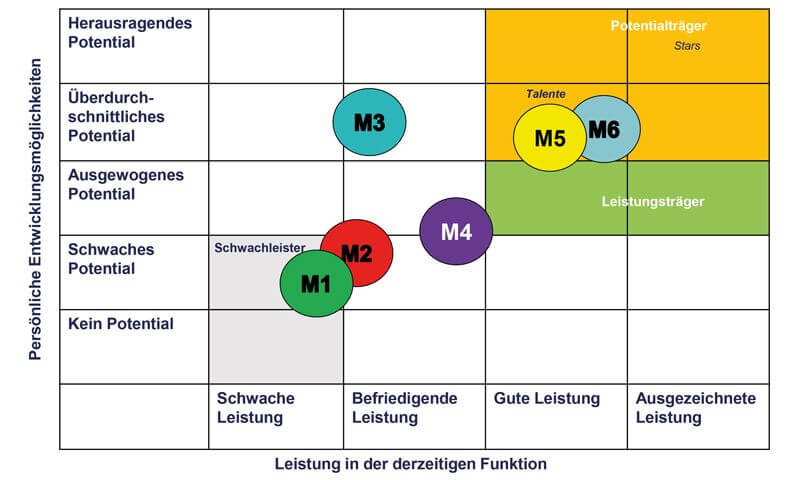
Delimitation of the performance review
We have already described management based on operational objectives elsewhere. Similar methods are used here, but the performance appraisal is more about the general requirements of the position, whereas the target agreements are more about annually redefined priorities from the focus of the corporate strategy – the results can therefore differ considerably in some cases.
However, the performance review goes beyond individual, usually event-related employee appraisals during the year, e.g. feedback, criticism, development meetings, etc. The employee is entitled to a regular assessment of their performance. As the term “re-view” suggests, this is a recurring review, and the development of an employee over the years is also an important factor in the performance review.
Making performance reviews successful
The article already contains numerous tips on how the performance review can become a successful, target-oriented and recognized management tool in the company. In the following, we have summarized and supplemented this article with 5 tips on what managers should pay particular attention to in their performance review:
1. give the performance review a significance that does justice to its importance; prepare well, make a note of relevant examples of behavior throughout the year, take time for the meeting and create a pleasant, stress-free atmosphere. Performance reviews are not a “time waster” but a manager’s original task!
2. act interactively; let the employee have their say, give them the opportunity to express their own opinion and ask them how they rate your cooperation (factually!).
3. agree on concrete measures; document these and check their implementation and possible follow-up at the latest in the next review.
4. also think long-term; point out career paths, communicate this with the HR department and your line manager, stand by your promises.
5. keep the performance review “state of the art”; continuously check that the defined requirements are up to date, adjust competencies if necessary, consider the employee’s potential as well as their performance.
Final chapter
You want to identify and promote your top performers. You want to close gaps among your employees, motivate them and challenge each individual according to their skills and knowledge. You also want to keep your talents in your own ranks and develop them further, stabilize your personnel planning and ultimately expand the success of your company.
In my opinion, these are all good reasons to install a well thought-out and sustainable performance review process in your company.
by Uwe Conradi, trainer at Lorenz-Seminare