


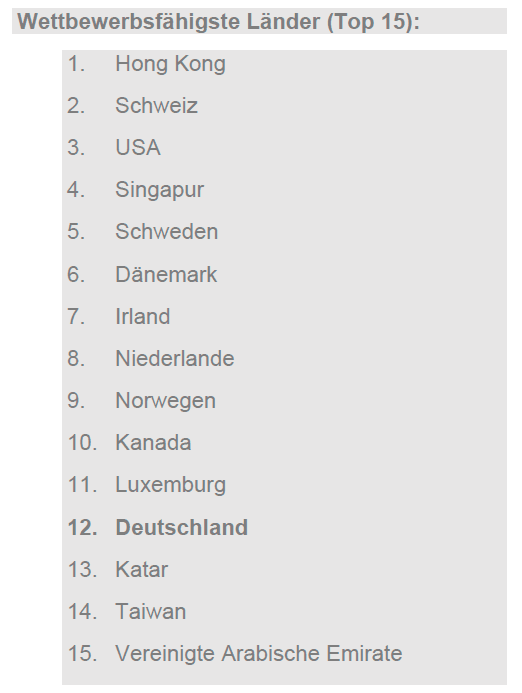
Despite all the crises and difficulties in Europe – from the influx of migrants to the financing of Greece and Brexit – the economy is booming and the unemployment rate in Germany has just reached a record low. Technologies and expertise “Made in Germany” are in high demand worldwide. However, there is no reason to rest on the laurels of the past. In the current competitiveness index (source: IMD Switzerland), Germany has slipped from 6th place to 12th. The East in particular is catching up vehemently. This is a loud warning sign and can also be a motivation to work even harder to keep up with the best competitors. It’s much more fun to be right at the front than just paddling around somewhere in the midfield.
The state has a lot to do in concrete terms. Especially in the area of infrastructure, which in Germany is increasingly lagging behind its competitors in the market. But a great deal can also be done on the corporate side to achieve greater success. Contemporary, creative and future-oriented concepts in the areas of marketing and sales are particularly in demand: even more focus on the customer, even more forward thinking. In the B2B sector, consultative selling is particularly popular. In this concept, customer orientation means fully immersing yourself in the customer’s business model and working on solutions for their goals and strategies.
Communication is one side of the business
 Source: IMD, Switzerland, 2016There is no doubt that motivation and communication play a key role in the lives of successful salespeople. However, customers in the global, highly competitive market expect much more than eager-to-please and rhetorically skillful interlocutors. This applies in particular to the all-important markets in the capital goods industry, automotive and the entire B2B sector in general. Many companies optimize their purchasing processes, not least thanks to very good information systems based on a sound business foundation. The ruthless “price-down-at-any-cost” approach is increasingly giving way to more intelligent, but also more complex purchasing and sales processes. The interrelationships and effects of the most important parameters of cost, quality and time must constantly be brought into an optimal relationship with regard to a company’s market objectives. Ideally, this brings together business partners who understand each other very well and help each other to achieve their business goals. What does this mean for the sales side? Whereas not so long ago, those in the sales profession who could even “sell an icebox to an Eskimo at the North Pole” were considered to be something special, in today’s extremely transparent market, the salesperson is someone who achieves the best solutions for their customers – both technologically and organizationally/business-wise. He understands his customer’s business model, can identify with their business objectives, analyzes the specific solution requirements and necessities and combines the possibilities of his own company with the actual needs of the customer in a forward-thinking manner.
What customers really need
A solution is a solution if, from the customer’s point of view, it advances one of their business plans. In the case of companies, this is always at least profit and growth. In addition, there are individual goals such as market positioning, green business, social commitment, technology leadership and any other individual goals. In the case of state organizations, these can be goals such as infrastructure development, supply, waste disposal, social services or military strength. Even in the government part of the business – and this is a good thing – business management principles are being applied with increasing acceptance. Costs, quality and time are becoming increasingly coordinated.
Although these three variables are of a fundamental nature and affect every company and almost all organizations, we naturally find interesting differences in the individual characteristics. Manufacturing companies differ significantly from service companies, industrial companies from credit institutions, research institutions from logistics companies, retailers from consultants and generally companies from state institutions.
Individual solutions can therefore help to plan company resources such as personnel deployment more intelligently, increase machine utilization through automatic service indicators, control production processes more intelligently, minimize potential risks or even accelerate the development of new products (one of the most important success factors in many industries). This reduces the amount of capital required for this, thus at least sparing the nerves of controllers and creditors and ensuring greater competitiveness through a better time to market.
No box pushing
Even a brief examination reveals that the sale of solutions differs significantly from the sale of products. The closest we can come to selling high-quality services in the B2B business is design, consulting or training.
Let’s take a look at the target group of purchasing decision-makers. The more the business principles have penetrated the customer company, the more purchasing decision-makers want to be convinced not only by the product and its features, but also by a clearly recognizable business benefit and commercial logic. The benefit must have an impact on the company’s own area of expertise or, even better, on the entire company or the purchasing object to be negotiated, and must be presented in concrete key figures. A convincing combination of technology, service, increase in knowledge and presentable, feasible costs is required.
Discussions, negotiations and presentations at board level are often part of the sales process, especially in medium-sized companies. A CFO Chief Financial Officer is more interested in the impact of a business on the cost structure, possible improvements in cash flow or depreciation values than in the functional layout of technology parts. He is responsible for his commercial figures, he knows his way around them, and this is where he wants to be addressed and convinced. To a large extent, this also applies to contacts in purchasing functions. At the very least, technological aspects are weighed up against commercial considerations and, ideally, reconciled. It is not always the lowest price that counts, but rather the most convincing overall argument. The best expected ROI/return on investment is decisive, provided it can be demonstrated.
Business knowledge for salespeople
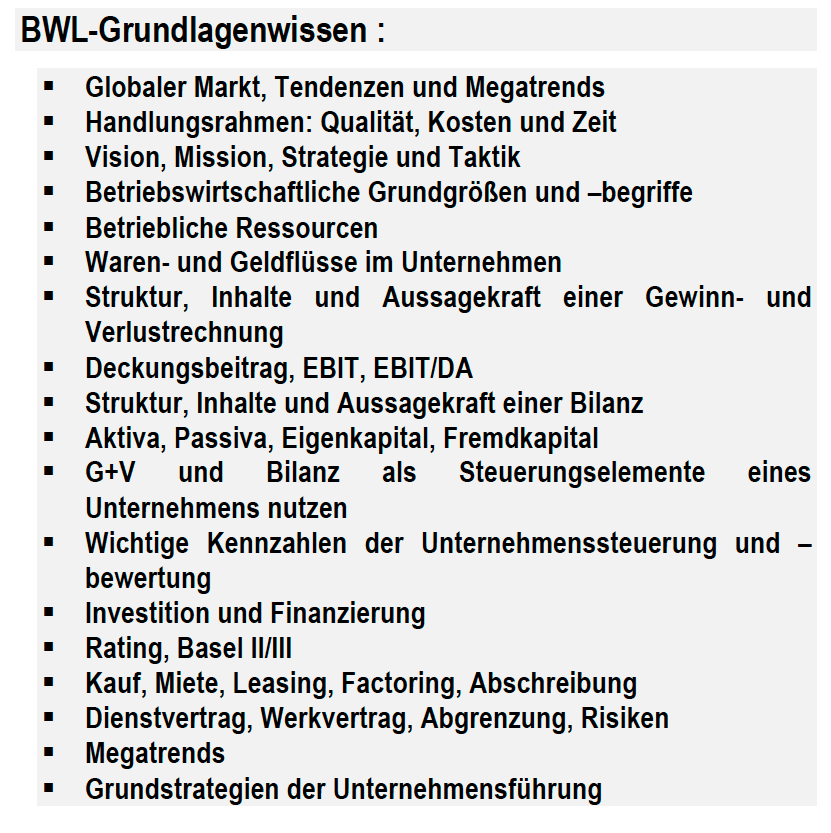 So what knowledge do our salespeople need in the solutions business? Here is a brief summary of the most important aspects:
In addition, an interest in the market and the respective trends is required. The globalized world brings plenty of opportunities and, of course, some risks that companies need to be able to navigate safely. Business administration is not something isolated. A company operates in the market, which is part of society and this in turn is part of the global world. It is the understanding of interrelationships that increasingly defines the business and not isolated individual decisions.
Develop profile
Universities have already responded successfully to these changes. More and more students are enrolling in subjects that combine technological expertise and business administration. Industrial engineering is currently one of the most popular courses of study. This is a good thing, even if the expected output of the universities will not sufficiently cover the high demand for specialists.
The companies themselves are also in demand here, as are those responsible for personnel development.
Many salespeople with good product knowledge and sales experience simply lack business terminology and the odd gap in their understanding of business contexts needs to be filled. Realistically, only a small, elite group of people who are already active can afford to do this. For the majority, this is not necessary.
This missing knowledge can be built up and expanded very well in compact seminar formats. Occasionally, there is a lack of methodological knowledge on moderation and decision-maker-oriented presentations. These can also be covered in in-house training courses. Even in medium-sized companies and not just in large global corporations.
In addition – and this is essential – a change in the salesperson’s understanding of their role is required. The (previous) product salesperson was and is “trained” to know his products inside out in order to bring them to the forefront of his offer in sales talks. The solution-oriented salesperson first looks at the customer company’s business model and, in conjunction with their own services, searches for potential for improvement; they analyze the company’s current situation (annual report, Internet, press) in advance and then work with the customer to develop solutions for their goals and plans.
Ideally, the solution seller is a customer consultant with sales responsibility. Someone with sufficient detailed knowledge of products and services, but without getting lost in them. He is therefore more of a generalist than a specialist. In any case, the task of solution selling is a very appealing and exciting one.