


Building, developing and successfully leading a team is a core competence in management tasks. But is a team the same as a team? Framework conditions, goals and compositions can be very different. Individuality is one of today’s megatrends. Individual measures are called for in order to lead teams to a high level of performance.
Short review: Dynamics in groups
We have already discussed the importance of group dynamics in team development in previous articles. We can almost always observe four phases, four stages of development (see Bruce Tuckman’s “team clock”) one after the other. In the first stage (“forming”), most teams tend to behave cautiously and seek orientation. In this first phase, leadership consists above all of keeping everyone involved well informed. The framework conditions are presented, goals, participants, tools – simply everything that gives everyone a quick, rough overview. Questions and answers determine the dialog here. Clarity and simplicity are key. Once this overview has been established, the second phase (“storming”) begins. The team deals with the circumstances, discusses, fights for concepts, procedures and positions. Moderation is called for in leadership. Teams that “fight” too quietly need stronger impetus to do so. Teams with too much energy need a little more moderation and sometimes protection for individuals. Team players who are too quiet are encouraged, while those who are too loud are sometimes taken back. It is important that concepts, opinions and ideas are put on the table and that controversy is made possible. Once these things have been discussed, the next step is to reach agreement (“norming”) within the team. Goals, rules and positions must be brought together. The better this is achieved, the greater the success of the fourth phase (“Performing”).
Unleash performance
This fourth stage of team development is the “real goal” of the process. This is where the team works together and concentrates fully on achieving the common goals. The more the team gets into a state of FLOW here – and stays there for as long as possible – the higher the team performance. I would like to share with you a very nice definition of FLOW from the web (Wikipedia, 2018): “Flow describes the exhilarating feeling of a mental state of complete immersion (concentration) and complete absorption in an activity that happens as if by itself – in German: Schaffens- or Tätigkeitsrausch or Funktionslust.”
This FLOW state also needs to be set up, which includes our group dynamic process as well as ongoing care and support from the team leadership.
Making the most of diversity
Teams differ greatly in the performance phase due to their goals and the corresponding composition of the team.
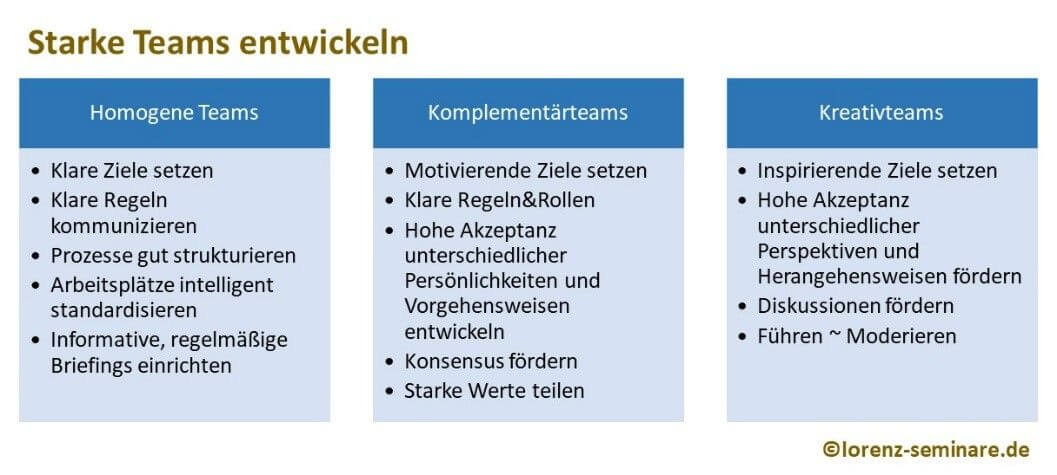
Broadly speaking, we can identify three common team forms and one special form. Ideally, each is managed, challenged and supported in a slightly different way. We have homogeneous teams when more or less everyone in the team performs activities, uses workstations and occupies positions that are all very comparable or even more or less identical.
In complementary teams, the team members perform different tasks and hold different positions. Ideally, they complement each other with their strengths and thus cover the entire required performance profile. This can be compared to a soccer team. The different tasks in the team, from goalkeeper to defender, midfielder to center forward, are performed by different skills and together they form a complementary team. Of course, this also includes the coach on the sidelines, even if he has the regulating, moderating function and does not have to be directly active on the pitch himself.
As soon as the focus of the objectives lies in the creative/design area, we speak of creative teams. They absolutely need freedom for new ideas, alternative approaches, controversy, time for discussion, acceptance of both/and solutions and not just either/or. The appropriate leadership of creative teams then takes the form of moderation rather than strict instructions.
Crime scene atmosphere
We are familiar with the following situation from exciting crime films: a person disappears, perhaps even a child. Has it run away or has it been abducted? The police are called in and the situation is urgent. Experts from various fields immediately join forces, form a special commission and get to work without even a moment’s hesitation.
Everyone is aware that the faster everyone agrees and gets to work together, the greater the chances of success and rescue. Every hour, every day counts.
Haste and pressure to succeed form the framework conditions for a special commission and are also its stimulators. The goal itself is pure motivation and almost automatically binds everyone involved together. No discussions about boundary conditions are helpful here, everyone is aware of that. The only thing that counts is full concentration on moving forward and achieving the goal. Everyone involved is fully committed, relies on their strengths and uses them beyond their usual limits. The head of the special commission also has an important special task. He has the team’s back and, in case of doubt, provides drinks without the help of an assistant, makes coffee and is simply always present, available and supports everyone. He is exemplary: everything is possible here, everyone is there for everyone, everyday rules are not important now.
This form of group organization and teamwork is also very useful in business. It should be clear that it is limited to a short period of time and reserved exclusively for special tasks and exceptional situations. This means that the objective should be both urgent and important. In this form of work, the usual rules of the game that are important in everyday life can be disregarded in order to open the door wide for unusual ideas and approaches.
In the long term, the special commission is a very important management tool for the development of particularly performance-conscious teams. A team leader should “confront” their team with this form of work at least once a year. On the one hand, to check the actual ability to call on maximum performance (and not just assume it), and on the other hand, to increase the team’s performance in the long term and make it retrievable. The special commission offers direct performance feedback for everyone. It makes it clear in a very practical and tangible way where a team’s strengths and weaknesses lie and how the profile of a working group is changing. In addition, unless it is actually a kidnapping, as in a thriller, it creates excitement, enjoyment of work, interesting insights, more and more team spirit and a growing bond between the team members.
by Karl Heinz Lorenz