



There are quite a few personality tests on the market. Whether 16Personalities, Big Five, DISG or Hogan – what they all have in common is that they are very comprehensive, well professionalized and, above all, used intensively in the world of work. We provide an overview of the most common tests, explain the differences to the Riemann-Thomann model and show the progress and significance of the tests for personnel selection and for communication in sales and consulting. We also explain the DNDW-Test®, which is based on the Riemann-Thomann model and is therefore considered the Riemann-Thomann model test.
Cover image by Joshua Fuller on Unsplash
Personality tests – their advantages and disadvantages
Personality tests are generally used to assign oneself and one’s behavior to a certain pattern and to draw conclusions about behavior. They analyze individual characteristics, including strengths and weaknesses, and thus make it possible to develop the personality more consciously. Valuable tips can also be derived from the patterns identified (for example for communication with others or targeted further training).
The common tests have in common that they are very extensive and almost over-professionalized. As a rule, they focus on general behavior and typical characteristics. It is also important to remember that personality tests represent a snapshot in time. Traits develop, can change or appear differently in a different test situation. The largest and best-known tests are
16 Personalities
The test from 16personalities.com is probably the most comprehensive and accurate test. In a test that can be completed in a maximum of 12 minutes, you are classified into four basic categories: analysts, diplomats, guards and researchers. Among these, there are four types each, such as the adventurer, the logician, the protagonist or the architect.
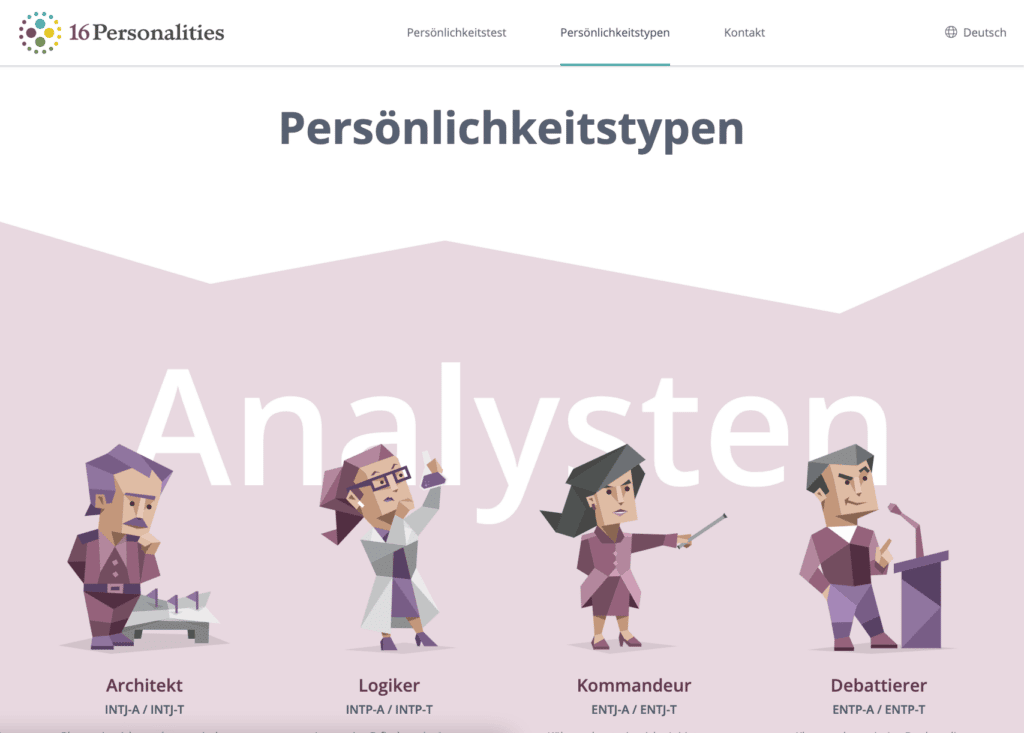
However, this categorization and the underlying motives can also vary enormously depending on the mood of the day and change over the years.
Big Five Test
The Big Five itself, on the other hand, is based more on the basic pillars of personality. This is not necessarily a test per se, but a model of personality psychology. It is categorized into the five dimensions of “openness to experience”, “conscientiousness”, “extraversion”, “agreeableness” and “neuroticism”. Various websites and companies offer a wide variety of tests on this topic, e.g. Greator.
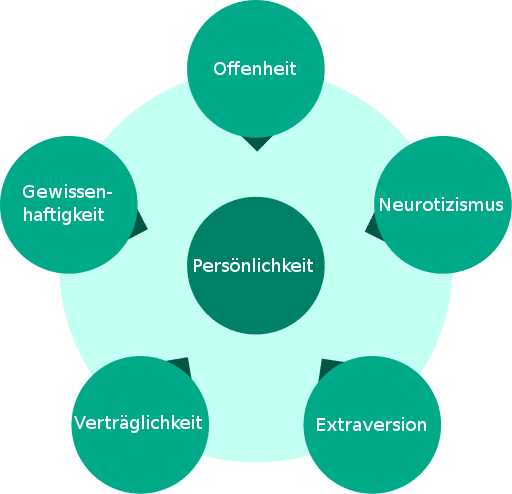
The Big Five are just as weighty, comprehensive and broadly defined as they are difficult to transfer to everyday business life. Depending on the situation, a person can find themselves in a different dimension and act differently.
DiSG® test
The DiSG® test, also known as the four-color model, probably offers the most detailed evaluation and interpretation of the personality tests. This involves classification into four types or colors: D for Dominant (yellow), I for Initiative (yellow), S for Steady (green) and G for Conscientious (blue). The individual characteristics are very different and vary enormously.

The DiSG® test is the only test in this comparison that is associated with quite high costs (approx. €200). Another problem with this test is that the underlying personality model has not been validated at all, the test is considered outdated and ignores the findings of personality research since the 1920s. The lack of validation also calls into question the widespread use of the DISG® model in personnel development. It is simply popular.
The Riemann-Thomann model and the DNDW principle
In contrast to DISG®, the Riemann-Thomann model is a psychological model used to illustrate a person’s typical behaviours and actions through identifiable, polarized basic orientations. A basic orientation is to be understood as a state of well-being, a comfort zone, which the respective person strives for as often as possible depending on their type. In the Riemann-Thomann model, the basic orientation is therefore also referred to as basic aspirations.

Depending on the personality, two or sometimes only one of the four opposing basic strivings are decisive for perception and behavior. These have a direct influence on communication and relationship behavior. The four basic strivings are:
- Distance orientation (D)
Freedom, individuality and rational thinking and action (figures, data, facts) are particularly important - Proximity orientation (N)
Strive for love, closeness and affection and build on trust and sympathy and are very sociable - Permanent orientation (D)
Security, consistency, stability, planning, goals and reliability - Change orientation (W)
Everything new and changing is in the foreground, risk and new ideas are welcome, sometimes chaotic
The special feature of the Riemann-Thomann model is that the basic orientation rarely changes completely over the years. Through upbringing and impressions during development and the past life, these orientations and behavioral patterns are further developed. This is why the model and a personal Riemann Thomann Model test offer enormous opportunities for using them in sales and recruitment.
Advantages for sales
A practical example: Imagine a very technology-oriented salesperson, knowledgeable in all the facts and figures of his products (duration/distance type). The customer opposite in this example is a person who likes to try out new things and wants to be empathetically perceived, questioned and advised by a friendly salesperson on a human level (proximity/change type).
Although the salesperson provides technically convincing, crystal-clear references and has years of experience with this product, the customer is unfortunately unenthusiastic and leaves. Frustrated, the salesperson no longer understands the world.

This is everyday life in sales and distribution. Two completely opposing worlds and therefore basic orientations with completely different decision-making motives collide in a polarizing way. The Riemann-Thomann model and the DNDW-Test® help you to better categorize yourself and your own motives when dealing with others. In this way, you can consciously prepare yourself for different types of customers with different decision-making motives and adjust to them in discussions.
If you know that you are a distance-oriented person, you will be better able to pick up a customer of the proximity type from the very first moment, respond to their needs in a more targeted manner and close a deal much more easily. This will help you avoid customer conversations in which you talk past each other.
Effect in the personnel management of sales departments
The DNDW-Test® can also support personnel management in sales departments or sales-centered companies when recruiting sales staff. Potential candidates can, for example, be sent a questionnaire during the pre-selection process that shows which of the four basic tendencies the applicant has. As the HR manager, you can then prepare optimally for interviews and determine much more efficiently and quickly whether the potential applicant is suitable for the position and task on offer.

The model can also be useful for selecting applicants: If you work in an industry where you tend to maintain a friendly relationship with customers, an applicant with the basic orientation of closeness is probably better off than one of the distance type. It should be mentioned that all personality tests reflect characteristics and tendencies, but – no matter how comprehensive they are – they do not represent definitive judgments. Tests always make sense in conjunction with personal, expert discussions. They are an excellent supplement, but not the last word in wisdom.
The DNDW-Test® as a Riemann-Thomann model test
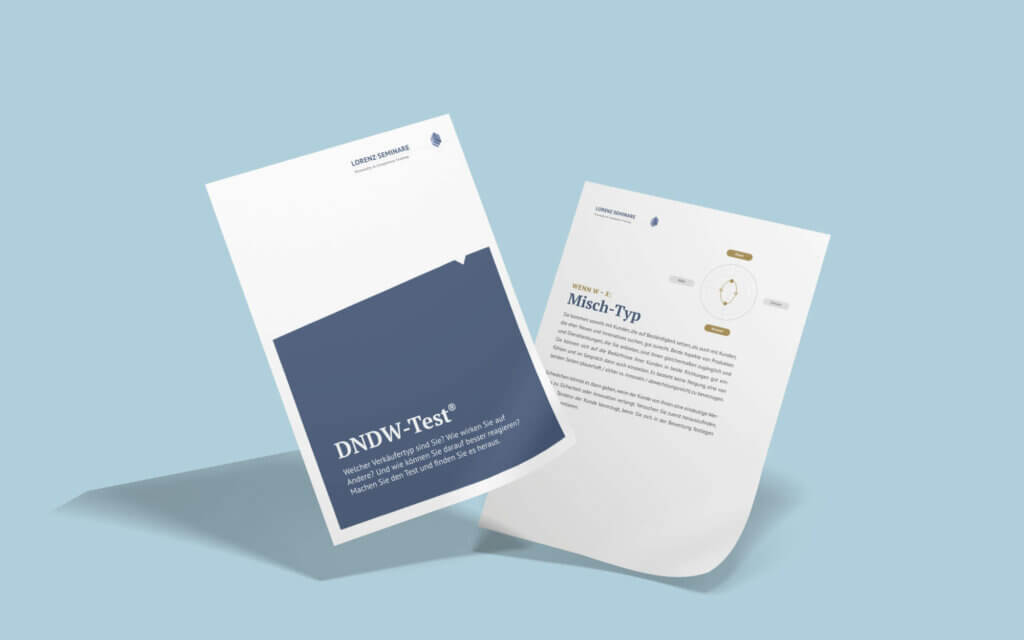
We at Lorenz-Seminare have developed the DNDW-Test® for these situations, which helps you to better categorize your basic aspirations with nine short, crisp questions. The test is an excellent way of taking a more systematic look at your own wishes and decision-making motives. A real boost for the conscious development of your authentic personality.
In coaching sessions, we also offer interpretations, conclusions and tips for action on your sales behavior that you can use immediately in your next customer meeting. We offer the DNDW-Test®, which has already proven its worth in countless in-house training sessions and personal coaching sessions since its publication in 2007, free of charge for a limited time.
Here you can find more information about the test and register for the test.