


For thousands of years, man and dog have formed an unbeatable symbiosis, so dogs can be described with a clear conscience as man’s sixth sense. Dogs and their primal instincts have been used for hunting and herding for a very long time. However, humans have also recognized that these primal instincts can be developed and used almost at will. Good examples of this are the drug search dog, the rescue dog and the guide dog. But this extension of tasks, which at first glance seems sensible and understandable, is by no means everything. People also take advantage of the fact that dogs are simply dogs and thus have a positive influence on human life. Surely almost everyone has watched a child playing wildly with a dog and noticed the pure joy of life on both sides.
Even in the business environment, dogs are being used more and more. Dogs have been proven to have a positive influence on corporate culture and the well-being of employees(see this article, among others). This has also been recognized by two of the world’s largest and most progressive companies. Amazon “employs” around 6,000 four-legged friends. Google even goes so far as to call itself a “dog company”.
I ask myself the question: why don’t we use the fabulous qualities of dogs to an even greater extent? For example, as co-trainers in adult education. And this is exactly where dog-assisted leadership training based on the coachdogs® principle comes in.
Why is dog-assisted training successful?
“I have great respect for my dog’s knowledge of human nature. He is faster and more thorough than me.”
Otto von Bismarck (1815-1898), German politician and statesman
Otto von Bismarck recognized a long time ago that dogs have a very good understanding of human nature. But what is actually behind this assessment? In a nutshell: Dogs are extremely attentive and have a sensitive perception. They give humans direct and non-judgmental feedback. They are always congruent and have no “hidden agenda”. They only follow humans in a sustainable manner if an appropriate leadership style is applied and a relationship of trust is established.
Feedback, congruence & the blind spot:
There is no question that feedback is important for personal development and constructive and successful cooperation. That’s why almost every company nowadays calls for a feedback culture. But as we all know from our own experience, the desired feedback culture has its limits. For example, who would like to successfully inform their boss about their personal development potential in terms of empathy and social skills? This is where dogs come in and can help us.
Dogs are very attentive. They constantly read and observe humans. They react to human actions and are always congruent, i.e. their thoughts, feelings and actions are in harmony with each other. These characteristics make dogs the perfect sparring partner for non-judgmental and honest feedback.
A Harvard Business Review study confirms that people are only suitable as feedback providers to a limited extent anyway(more on this here). The essence of the study is that people like to receive feedback and prefer negative feedback. Why? Negative feedback identifies development potential that you can work on to improve. However, the study also reveals that people unfortunately only receive this desired negative feedback sparingly. Why? People are reluctant to give feedback anyway and when they do, they prefer to give positive rather than negative feedback. The reason for this is various, often subconscious, constraints and inhibitions. Dogs do not have these human constraints and inhibitions. By holding a mirror up to us through their reaction to our actions, they painlessly and mercilessly illuminate our behavior. In doing so, they uncover both positive and negative states and characteristics.
Good leadership:
Leading a group to success requires a confident, appropriate leadership style and a positive team culture. Clearly, it is not possible without defining rules, having the courage to make uncomfortable decisions, setting the direction and motivating. However, the foundation for good leadership is undoubtedly a healthy relationship of trust. Only when this relationship of trust is established do employees achieve the status of “psychological safety”, which, according to a study by Google(here), is the most important factor for successful teams. Essentially, this status means that employees believe they can take certain risks without fearing negative consequences.
But an appropriate leadership style is needed not only at the human-human level, but also at the human-dog level. Dogs also need to trust in order to feel safe. Dominant behavior is not the only way to achieve lasting success with dogs. Thanks to their sensitive character, dogs are therefore ideally suited to developing people in terms of confident leadership.
How does the transfer from theory to practice take place?
We are all familiar with various communication models from theory. Be it the Johari window with the often cited blind spot, the 55-38-7 rule for non-verbal communication according to Mehrabian or the 4-ear model according to Friedemann Schulz von Thun. We’ve all heard of them and can relate to these models. Unfortunately, the crux of the matter is that we lack the tangible transfer into practice. This is where dogs can help us as co-trainers. How? Various theoretical models are made tangible and understandable during training through practical exercises with the dog at the human-dog level. The findings are then transferred to the human-dog level and to the participants’ day-to-day work.
How does a training day actually work?
Get to know us:
The first and extremely important milestone is for the participants to get to know each other. The four-legged co-trainers are already involved here, as they can provide the best support in creating an atmosphere of trust. Only when this is in place can a healthy group dynamic develop that allows the group to work effectively.
Status quo determination:
After getting to know each other, a kind of stocktaking is carried out. The aim is to elicit a self-assessment from the participants with regard to their leadership skills and thereby “draw” a kind of self-image. To this end, the participants are asked two key questions.
1. how do I want to be perceived as a manager?
2. what characterizes my management style and what is important to me?
By answering these questions, the participants develop a self-image. From this point on, this can be “channeled” through the exercises with the four-legged co-trainers.
Practical exercises:
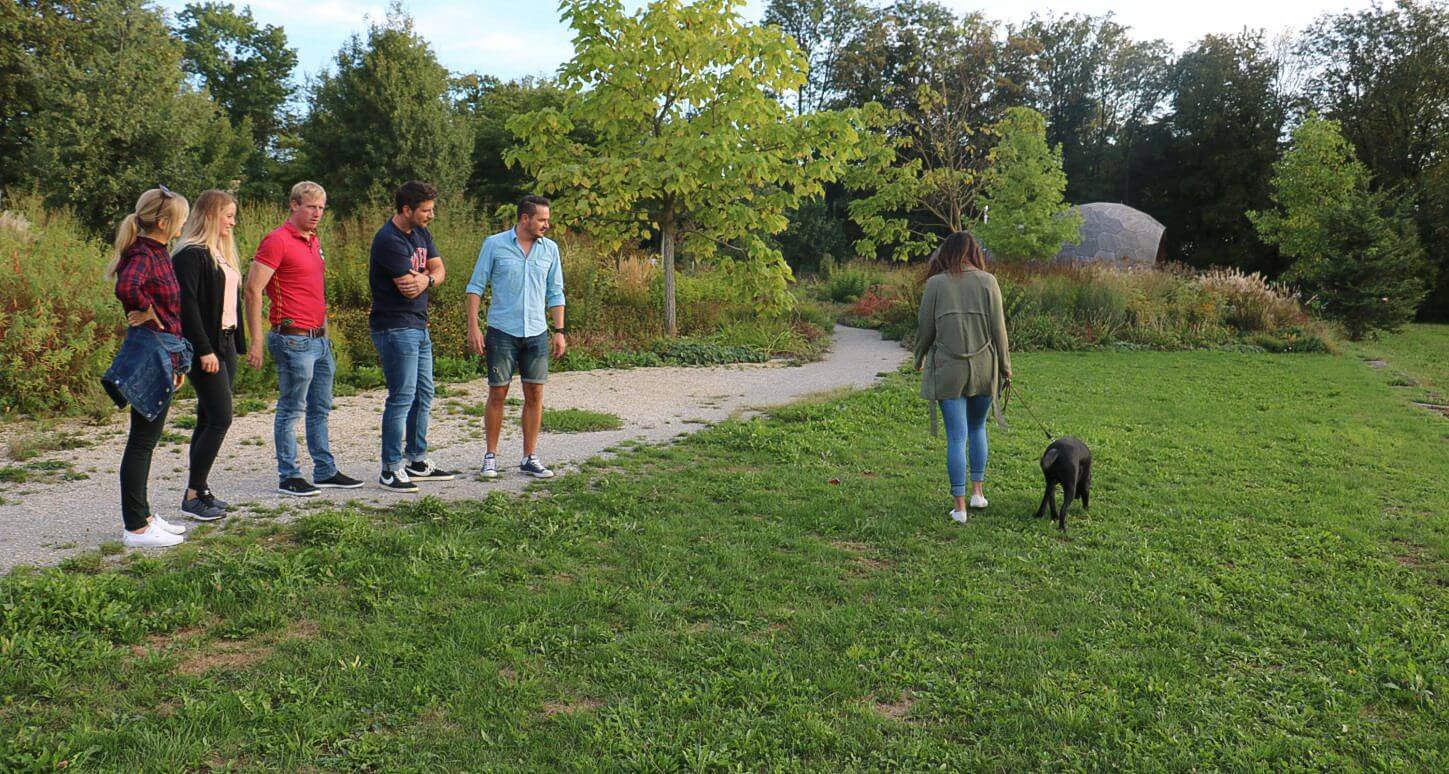
In the practical part, the participants carry out various exercises with the co-trainers. One participant always takes on the active role and carries out the selected exercise with the co-trainer. The other participants take on the role of observers or feedback providers. The exercises can be divided into four categories:
Leash – I lead
The participant demonstrates his leadership qualities. Various skills come to the fore, including confidence and clarity.
Taboo – I set boundaries
The participant sets boundaries and thereby demonstrates assertiveness and congruence, among other things
Motivation – I invite you
The participant acts as a motivator and demonstrates his skills in terms of creativity and spontaneity, among other things
Call – I decide / trust
The participant decides, organizes and thereby expresses his/her talent for, among other things, persuasion and decision-making skills
Reflection and transfer:
Immediately after the exercise and while still on the training ground, a short reflection takes place in the group and initial observations are exchanged. After returning to the training room, there is a detailed reflection on the video material in the group. As part of this group discussion, the self-assessment generated at the beginning is included and a comparison of self-image vs. external image is carried out. This results in extremely interesting findings with regard to the individual development potential of each participant.
Be brave and give it a try
We all often look appreciatively at Silicon Valley. We are impressed by the success and courage of the companies based there. One of the main reasons is undoubtedly the corporate and management culture practiced there.
Based on the examples of Google and Amazon, we can see that dogs make a valuable contribution to a successful and positive corporate and leadership culture in companies. Why not let the sixth sense of dogs help you to become an even better leader in order to positively shape the corporate and leadership culture of your company?
by Conrad Brech, Coach at Lorenz-Seminare