


Whether in training sessions or workshops, in coaching sessions or conversations on the sidelines of professional projects – I am repeatedly confronted with the situation that people feel “strange” in their specific job or simply in their immediate professional environment in general. How genuine can I be and how much do I have to “bend”? If this important question cannot be answered well, satisfaction suffers and very often also the inner conviction of being able to do a good job and thus be successful and happy. Reason enough to take a closer look at this issue.
About roles and individuals
No matter what we do professionally or where we are, we are practically always a combination of our naked, pure existence in connection with a role. We are human, we are individuals and at the same time we have a professional function. This is linked to a (functional) understanding of a role, a role expectation and a role behavior. Whether employee or supervisor, salesperson or buyer – there are any number of professional roles and descriptions. At the same time, we live in an age in which individuality has taken on a very high significance for our well-being. It is one of the so-called “megatrends” (see www.zukunftsinstitut.de) worldwide. Living up to a role, “functioning”, and at the same time asserting a high degree of personal individuality in order to be happy – expectations collide that are not so easy to reconcile. How much of a role can I play in order to still be genuine, how much individuality can I assert and still function well in my role for my company, my professional task? An extremely exciting question and what is the reward for finding a good answer to it?
A few bars of theory
Authenticity is generally defined as a critical quality of perceptual content, which can be objects, people, events or even human actions, which presupposes the contrast between appearance and reality as a possibility of deception and falsification. Such perceptual content is considered authentic if both aspects of perception, the immediate appearance and the actual being, are found to be in agreement.
What seems so important about being real?
The concept of authenticity has been around for quite a long time (see Socrates, Plato, Aristotle), but it only became more significant in the context of personality development in the more recent Romantic period (Charles Taylor, Descartes). Today we know from industrial psychology that people only achieve their optimum effect on other people with a high degree of authenticity. To put it somewhat generally, a successful combination of credibility as a person and credibility in the role they are currently playing.

For many functions in a company, personal credibility is extremely important for success in this role. Let’s think of managers or salespeople or experts with communicative tasks. Who would want to be led by a manager whose credibility is low? Who would want to be advised by a salesperson who can’t really be trusted? Who would want to be convinced by a technical expert whose credibility is questionable?
Especially in communicative professions, credibility, nourished by authenticity, is very important. We, the people, want to feel, see, smell and simply perceive that we can believe what we are told by the person we are talking to. As soon as doubts arise here, acceptance and respect become difficult. This is why a high degree of authenticity is almost always part of the profile in communicative professions.
As an additional aspect, apart from the business benefits, personal satisfaction in a role should also be taken into account here. If the role you play is “tailor-made” for you, you almost automatically have a greater sense of happiness, inner and then often also outer confirmation in performing this role(s).
From teaching and research – Social psychologists Michael Kernis and Brian Goldman distinguish four criteria for the experience of authenticity:
- Awareness: An authentic person knows their strengths and weaknesses as well as their feelings and motives for certain behaviors. Through this self-reflection, they are increasingly able to consciously experience and influence their actions.
- Honesty: This includes looking the real environment in the eye and also accepting unpleasant feedback, e.g. via feedback.
- Consequence: An authentic person acts according to their values. Values that they stand behind from the inside out. This also applies in the event that they suffer disadvantages as a result. After all, there is hardly anything more deceitful and dishonest than an opportunist.
- Sincerity: Authenticity involves the willingness not to deny one’s negative sides. At the very least, it means striving to recognize this.
Becoming more authentic
So how can we work on our authenticity, our genuineness and credibility? Separating the authentic from the supposedly genuine or even fake can be considered a specifically human form of world and self-knowledge. There are some theoretical models and very practical aids that can support us in this. At the very least, we should mention the Johari window, with which Joe Luft and Harry Ingham have given us a fabulous model that greatly simplifies something very complicated, namely the differentiation and handling of self-image and external image. Authenticity, as we have already seen, has a lot to do with perception. The perception of ourselves, pure or in a role, and the perception of ourselves from the perspective of others. Luft and Ingham show us clear ways of shedding light on personality and authenticity via the four personality areas that initially appear static (1. only visible to me; 2. visible to me and others; 3. only visible to others; 4. present, but not currently visible to me or others). This is primarily about enlarging the area of “visible to me and others”. If our own perception of ourselves partially matches the perception of others, then we also achieve a high degree of authenticity for everyone involved, including ourselves. 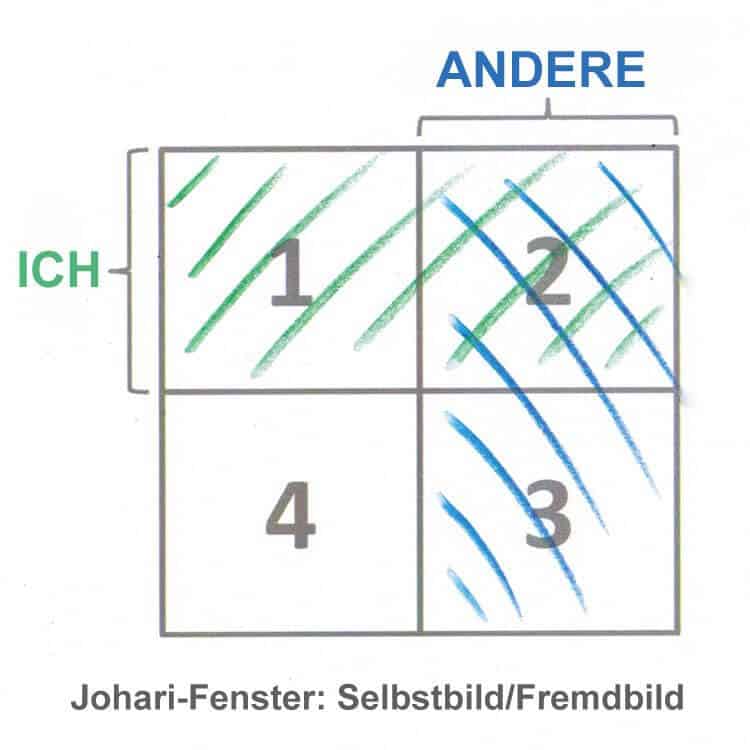
Becoming more open and showing more of ourselves is one thing we can work on. Reflecting on or directly questioning our behavior and the effect it has on others is the other. The former requires courage above all, because opening up more, revealing more of yourself, also means being more accessible and vulnerable.
Reflection and introspection require some time and quiet, which is often difficult for people in stressful jobs. It is important to consciously plan more time for yourself and to see this as useful time for your own personal development. In addition, direct feedback from others is particularly helpful. If you want to increase your authenticity, you cannot avoid asking those around you for feedback, which can be easy for some and very difficult for others. However, feedback – both giving and receiving – can be learned if this process is difficult or the quantity and quality do not meet our needs.
“What to do?” said Zeus
In my experience from my professional work, striving for authenticity and individuality should not become a dogma and is not an invitation to unbridled egotism. We don’t have to proclaim our inner opinion to everyone at all times in order to be perceived as genuine. I agree with one of our former German Chancellors, Helmut Schmidt, who was known for his almost uncompromising authenticity: “Don’t expect me to tell you everything I think. But you can rightly expect me to mean what I say.”
Anyone who strives for happiness and success in their career should, whenever possible, take up a job that they can stand behind and, if possible, in a way that convinces them. Do what you love, love what you do and do it with all your heart. It is clear that we are talking about an ideal state, a model. Life occasionally throws the odd spanner in the works in our efforts to achieve this, and ultimately that’s perfectly okay. It makes us fight for our goals, recognize our strengths and weaknesses, learn to appreciate successes and see setbacks as lessons.
Companies with a high understanding of values and a practiced sense of responsibility not only allow their employees and managers to be authentic, they actually encourage it. Completely in line with the fundamental corporate goals of making profits and growing: those who can and are allowed to be authentic in accordance with the company’s values feel much more committed to their company, have fewer thoughts of changing jobs and are more effective in the long term in their work for the company.
by Karl Heinz A. Lorenz