


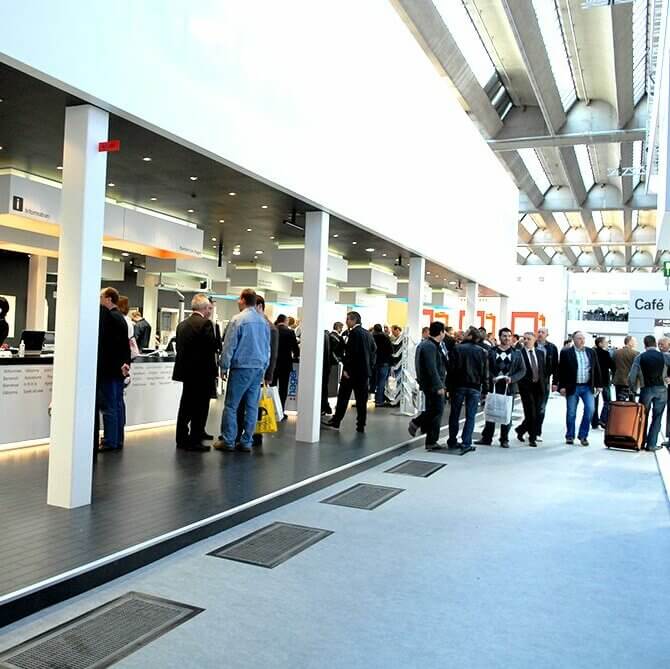
A successful trade fair needs many hard-working hands: a great stand design, exciting offers and exhibits, good promotion in the run-up and much more. On site, however, one factor is absolutely dominant: the team on the stand. When visitors and employees meet, it is decided whether all the preparatory work and investment has paid off.
Higher Self. And nothing else.
If we walk through a typical industrial trade fair, we see the following picture: stands that can hardly save themselves from visitors on one side and yawning emptiness and almost oppressive silence on the other. What exactly makes the difference? What makes one stand a magnet for visitors and what is so seriously wrong with others?
People look for people AND people are particularly attracted to those who radiate happiness, satisfaction and enthusiasm. It is a feeling of “the closer I get to this feeling of happiness, the more likely I am to participate in it.” The state in which we feel and radiate this positive attitude to life is called Higher Self. When we are in this state, basically everything we want to achieve comes to us, creative thoughts, skillful handling, diligence, self-confidence – and also other people, such as visitors to a trade fair. We have an attractive effect on others, completely from within. Not an act, but noticeably authentic.
So how can an individual slip into their higher self? How can even a whole team?
Serious trade fair work does not just consist of promotional support and stand construction. It takes exactly this kind of preparation, putting experts and a complete team into this Higher Self from the very first moment. What components bring this about? For individuals, this is often a combination of self-confidence, a zest for life, curiosity, the joy of growing and developing, motivating goals, good communication partners and health also play a role. If you want to get an entire team into the flow, into a higher self, then group dynamic processes come into play. Many individuals become a group, a group of individuals becomes a cohesive team. Francis & Young have empirically investigated the phases in which this team development typically takes place and Bruce Tuckman has used this as a model for the so-called team clock.
In the immediate run-up to a trade fair, a trade fair training / trade fair briefing uses precisely  this team-dynamic model combined with the work objectives (e.g. leads) and content (exhibits, argumentation, topics) to motivate the stand team and get them up to speed with the content in one go.
Phase model according to Francis, Young and Tuckman
- Forming: Getting started, contact and finding
- Storming: Dealing with the most important points and thus internalizing them
- Norming: Agreeing rules for the team
- Performing: Work and performance (the trade fair itself!)
- Adjourning: Resolution phase with success and positive impressions
The more attractive and competent the team comes across, the more successful the stand will be. Working at Higher Self from the first to the last visitor to the stand. Nothing less is required.
A few practical tips
The briefing itself
The trade fair participants are curious about the objectives and special topics of the upcoming event. They need information on the organization, the overall schedule and responsibilities. Clear, concise orientation is provided. Orientation also includes a visual, spatial view of the trade fair stand and the hall in which your stand will be located. After all, everyone wants to know exactly where they will be standing.
Actively involve all participants right from the start. Example: Have each individual briefly introduce themselves and their role at the trade fair.
Creative and constructive
The next step is to constructively discuss the important roles, tasks and content. Only when everyone in the team has been able to contribute their own thoughts can the common something, the team consensus, emerge. So in this second step, give the group the opportunity to discuss and allow for controversial opinions. The more the group immerses itself in the content and objectives, the more you internalize them. Tip: Divide the group (if large enough) and, with a little time pressure, assign tasks, the results of which are then presented in plenary. Example tasks: How do we want to address trade fair visitors particularly actively? How do we deal with peak times when the stand is particularly busy? How do we make ourselves particularly appealing to customers? What promotes our Team-Higher-Self?
Personal commitment
The task now is to merge goals, content, people and motivation into a whole. One team, joint performance, joint success. Establish simple rules on how to deal with the team itself and the visitors at the trade fair. This also includes the role of the stand management and their specific tasks during the event.
Do you know this from sport, perhaps from television, when coaches and players form a circle again before a game, put their heads together and virtually become one? It is precisely this kind of unity that marks the end of the trade fair briefings and is also the prelude to the start of the stand work. Attraction and motivation are strong feelings and it is precisely at the emotional level that they can be called upon.
Tip: Form a circle. Put your heads together. Ask each individual (or the trade fair trainer will usually do this) about their personal contribution to the success of the trade fair and have them formulate this in a short, concise statement. This creates a shared team spirit and the conviction that everyone is an important part of the joint success. Your Team-Higher-Self starts now.
by Karl Heinz Lorenz, trainer at Lorenz-Seminare